
Table of Contents
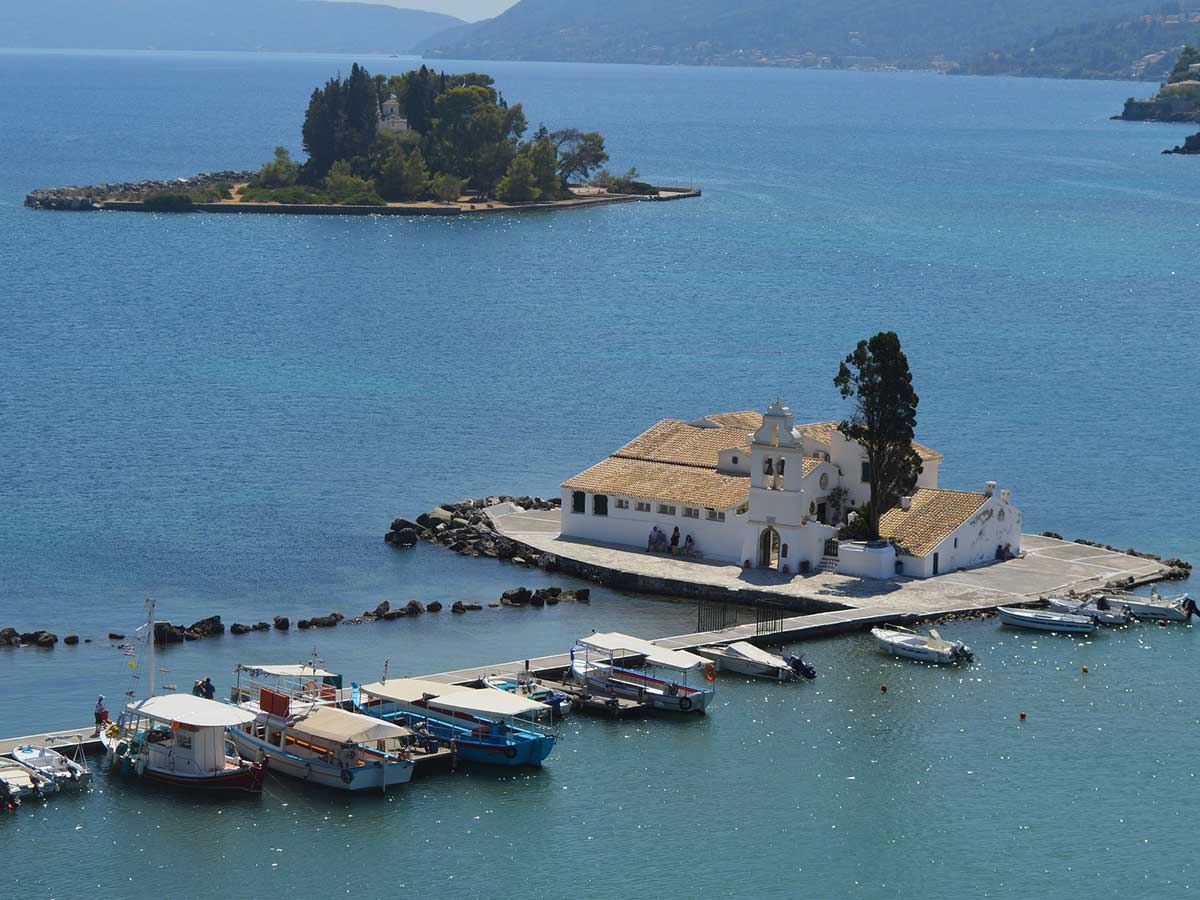
Pontikonisi, the tiny islet floating in the crystalline waters off Kanoni peninsula, ranks among Greece’s most photographed landmarks. This verdant speck of land, crowned by a whitewashed Byzantine chapel and surrounded by cypress trees, has captured imaginations for millennia. Connected to Homer’s Odyssey through ancient mythology and offering picture-perfect views from multiple vantage points, Pontikonisi embodies the romantic essence visitors seek in Greek islands.
The Name and Its Origins
Pontikonisi translates literally as “Mouse Island” in Greek. The name derives from the islet’s small size and elongated shape, which supposedly resembles a mouse when viewed from certain angles. Local imagination sees the cypress-covered island as the mouse’s body with the white chapel marking its head.This diminutive designation belies the island’s outsized significance in Greek cultural consciousness. Despite measuring barely 150 meters long and covered almost entirely by vegetation, Pontikonisi appears on countless postcards, travel guides, and promotional materials representing not just Corfu but Greek island beauty generally.
The Homeric Legend: Odysseus and Poseidon's Wrath
Ancient mythology provides Pontikonisi’s most compelling story, connecting this tiny islet to Homer’s epic Odyssey.
According to legend, after the Phaeacians (ancient Corfu’s mythical inhabitants) helped Odysseus return to Ithaca, Poseidon grew furious. The sea god had persecuted Odysseus for years after the hero blinded his son, the Cyclops Polyphemus. Seeing the Phaeacians thwart his revenge by providing safe passage home enraged Poseidon. As the Phaeacian ship returned to Corfu after delivering Odysseus, Poseidon struck it with his trident, transforming the vessel into stone. The petrified ship became Pontikonisi, forever frozen in the sea as warning against defying divine will.
Homer’s Odyssey (Book XIII) describes this transformation: “But the ship he rooted to the sea bottom, turned to stone, so that hereafter the Phaiakians would reverence the gods.” The Phaeacians, witnessing their ship’s fate, realized they could no longer offer hospitality to strangers, ending their tradition of helping lost travelers.
Archaeological perspective: No evidence links Pontikonisi to ancient settlements or structures. The mythology likely attached to the islet during Byzantine or later periods when educated locals familiar with Homer’s texts identified landscape features with epic events.
The Byzantine Chapel of Pantokrator
The 12th-century Chapel of Pantokrator (Christ Almighty) crowns Pontikonisi’s highest point, accessible via stone steps winding through dense vegetation.
Architecture: This tiny single-nave church follows typical Byzantine design, its whitewashed walls and terracotta roof contrasting beautifully against surrounding greenery. Interior frescoes, though faded, depict Christ Pantokrator in traditional stern blessing pose along with various saints.
Religious significance: The chapel functioned as pilgrimage site during Byzantine and Venetian eras. Small boat processions carried believers to the islet for feast day celebrations, particularly on August 6 (Transfiguration).
Current status: The chapel remains consecrated Orthodox property but rarely holds services due to access difficulties and limited space. Special occasions like name days sometimes bring priests and small groups of worshippers.
Visiting the chapel: Small boats operate from Vlacherna dock, ferrying tourists to Pontikonisi for brief visits (typically 10-15 minutes). The service runs sporadically, often suspended during rough weather or low season.
Vlacherna Monastery: The Connected Landmark
Pontikonisi shares photographic fame with Vlacherna Monastery, the white structure built on a tiny islet connected to Kanoni by narrow causeway. Together, these two landmarks create the iconic Corfu composition reproduced worldwide.
Vlacherna history: Built in the 17th century, this monastery honors the Virgin Mary Vlacherna. The name derives from Constantinople’s Vlachernae district, site of a famous Byzantine church housing a miraculous Virgin Mary icon.
Architecture: The monastery building features classic Ionian style with distinctive bell tower rising from red-tiled roof. The causeway’s stone pavement, lined with benches, provides access for visitors and worshippers.
Current use: Unlike many monasteries, Vlacherna remains active with resident nun maintaining the chapel and welcoming visitors. Services occur on major Orthodox feast days, particularly August 15 (Dormition of the Virgin).
Access: Walking the causeway offers intimate experience of this atmospheric site. The monastery interior displays icons, votive offerings, and religious artifacts. Respectful attire required (covered shoulders and knees).
The Kanoni Viewpoint: Photography Paradise
The elevated terrace at Kanoni village provides the classic vantage point for photographing Pontikonisi and Vlacherna together. This viewpoint has launched thousands of Instagram posts and travel blog headers.
Best photography times:
Sunrise (6:30-8:00 AM): Eastern light bathes the scene in warm gold, creating dramatic contrasts. Early timing avoids crowds and captures the monasteries in pristine morning light. Minimal airplane interruptions.
Golden hour (6:00-7:30 PM): Sunset light from the west produces magical effects, though afternoon winds sometimes roughen the water surface. Popular timing means sharing space with other photographers.
Blue hour (after sunset): Twilight creates ethereal atmosphere as monastery lights illuminate and the sky transitions through deep blues. Long exposures capture dreamy water effects.
Overcast days: Diffused light eliminates harsh shadows, creating softer, more painterly compositions. Lower contrast suits certain aesthetic preferences.
Composition tips: Include both Vlacherna and Pontikonisi in the frame for the classic shot. Foreground flowers (spring) or cafe elements add depth. Vertical compositions work well for social media. Long lenses isolate individual elements.
Airplane factor: Kanoni sits directly under Corfu Airport’s approach path. Landing aircraft pass dramatically low overhead every 15-30 minutes during peak hours, creating both photographic opportunities and composition challenges.
Alternative Viewpoints
From the causeway: Walking Vlacherna’s causeway offers unique ground-level perspectives looking toward Pontikonisi. Dawn and dusk create mirror reflections in calm water.
From boats: Tour boats departing nearby ports pass close to Pontikonisi, providing sea-level angles impossible from land. Some operators offer sunset cruises specifically for photography.
From Mon Repos gardens: Elevated positions in Mon Repos estate offer distant views placing the islets within broader coastal context, including the Old Fortress and mainland mountains.
Aerial perspectives: Drone photography (where legally permitted) reveals Pontikonisi’s true mouse shape and the causeway’s geometric beauty from above. Regulations restrict drone use near the airport approach zone.
The Perama Causeway Controversy
A controversial causeway proposal emerged periodically, suggesting direct connection from Kanoni to Pontikonisi to increase tourist access. Each time, the plan faces fierce opposition from historians, environmentalists, and locals who argue:
Environmental concerns: Causeway construction would damage marine ecosystems and alter tidal patterns around the fragile islet.
Aesthetic destruction: Permanent connection would ruin the islet’s isolated, ethereal quality that makes it photographically magical.
Overcrowding risk: Easy access would bring crushing tourist numbers to the tiny chapel, accelerating structural deterioration.
Historical integrity: Pontikonisi’s mythological and spiritual significance depends partially on its separation, maintaining sacred space distinct from mundane shore.
So far, opposition has prevented causeway construction, preserving Pontikonisi’s splendid isolation.
Visiting Practicalities
Location: Kanoni peninsula, 4 km south of Corfu Town, 2 km from Corfu Airport
Viewing access: Free from Kanoni terrace. Several cafes occupy prime positions, allowing extended photography sessions over coffee.
Boat access to Pontikonisi: Small boats depart from Vlacherna dock, 2-5 euros per person, operating May through October, weather permitting. Irregular schedule depends on demand.
Visit duration: Allow 30-60 minutes for viewpoint photography and cafe time. Add 30 minutes if taking boat to Pontikonisi.
Facilities: Cafes with restrooms line Kanoni terrace. Parking available but limited during peak hours.
Combining attractions: Easily combined with Mon Repos estate, Archaeological Museum, and Achilleion Palace in half-day itinerary.
The Perfect Time for Your Visit
Spring (April-May): Wildflowers bloom, temperatures stay comfortable, and tourist crowds remain manageable. Water appears especially blue against green vegetation.
Early summer (June): Excellent weather with long daylight hours for photography. Tourist season beginning but not overwhelming.
Late summer (July-August): Peak crowds and heat. Beautiful weather but expect company at viewpoints and cafes.
Autumn (September-October): Ideal combination of warm weather, fewer tourists, and excellent light quality. Sea remains warm for swimming nearby.
Winter (November-March): Dramatic storms create moody atmosphere. Boat service suspended but viewpoint photography offers unique perspectives. Cafes may close or operate limited hours.
Reaching Kanoni with VforVIP
Kanoni sits conveniently between Corfu Airport and Corfu Town, making it perfect first or last stop during your island stay.
VforVIP’s electric van service provides:
– Direct airport transfers with Kanoni photo stop included
– Flexible timing to catch optimal light conditions
– Comfortable waiting while you photograph and explore
– Knowledgeable drivers sharing local legends and photography tips
– Zero-emission transport respecting this pristine coastal environment
Our vehicles pass Kanoni multiple times daily on airport routes, allowing spontaneous stops when light conditions look exceptional or when you simply want to capture this iconic view before departure.